|
||||||
 |
 |
 |
 |
 |
||
|
|
About
Cape Cod Community Daré
* Daré (pronounced ‘dar-ray’): African Shona word indicating a sacred gathering for healing purposes In this section we hope to give you a flavor of what happens at Daré, which is typically on the last Sunday of the month. We also wanted to outline the inspiration for Daré, and its Zimbabwean roots, and also to outline the principles that are common to every Daré. Unfortunately Dare' is no longer being held Occassionaly Dare' is hosted by various members of the Dare' community. When Daré meets it is usually on the last Sunday of the month from 1:00 to 8:00 PM at the Longfellows Halls in Orleans, MA on Cape Cod, however, the DARE location, format & hour often changes so check your Dare' emails for details. If you're not already on the Dare' email list you can subscribed by emailing news@capecoddare.org for Dare' and other related local events Typical Dare' Schedule - often changes so check your e-mail 2:00 pm: Preparing the space. Please bring a potluck dish to share... and chair, instrument, and sacred objects for the altar, if able. Daré is an alcohol and drug free gathering. We hope you will join us. If you have any questions, call Paul 508-237-4422 or Renard: 860-309-7966 ________________________________________________________________ INSPIRATION AND PRINCIPLES INSPIRATION FOR DARE': The inspiration for Dare' came from Zimbabwe, where an indigenous healer, Mandaza (Augustine) Kandemwa, was instructed through dreams and visions to collaborate with other healers across boundaries of tribe, gender, skin color and country. Dare' offers us the opportunity to meet as a community-- to heal each other, and address the violence and greed in the world at large. Each of us comes with gifts and needs. Each of us has suffered, and that suffering can turn us back to our community with compassion. Spirit speaks differently, but profoundly, through each of us. Thus together we might find the wisdom to proceed on a path of peacemaking. PRINCIPLES OF DARE': 1. Dare' begins by calling in the spirits. Everything depends on this. The invocation allows Spirit to inform the participants. It creates a field of knowing and remembering. Dare' also centers on telling dreams and receiving dreams as gifts from the ancestors to the circle. Council and dreams are channels between the world of the living and the world of the invisibles. 2. The strength and essence of Dare' is in the circle and its intelligence. Council is its heart. Council is the process we use when we sit in circle as a community and discuss a topic or issue. We use the talking stick-- whoever holds the talking stick speaks without interruption, though with an awareness of sharing time with others who want to speak. And in council one always speaks from the heart, allowing the spirits and ancestors to speak through you. Wisdom comes from the combined voices and presence of everyone who is participating. The purpose of council is to seek answers, ideas and wisdom from the community that we can't find ourselves. Asking and addressing a single question coheres the community. 3. Music is an essential element of Dare'. For thousands of years, music has been a way for people to call spirit, and for spirit to manifest itself. Here, the voice, the drum, the dancing body, and other instruments are essential components for invocation, as well as healing. 4. Dare' is for the sake of healing, but we don't presume to say we know what healing is, how it occurs or even how, always, to recognize it. Sometimes one is the healer and sometimes one is desperate for healing. Sometimes the two activities are one and the same. 5. Another concern of Dare' is peacemaking. Again, though we don't always know how peacemaking happens, we have determined to make it the center and ground of council, asking spirit to show us how to proceed. 6. Everyone is welcome and welcomed in Dare'. Everyone is listened to and heard without judgement. This generous mind is not easy to attain; it takes time, practice and dedication. Welcoming, praising and blessing are at the core of it. Dare' is a place where each person's individual genius, intelligence and particularity is sought out, acknowledged and called forth. 7. There are no fees for Dare'. It is pot-luck food and drink. We are especially pleased when contributions are organic and substantial, as the time of Dare' covers two meals. There is always a community money basket at Dare'. Please add money if you can afford it. Please take money if you need it. 8. Children are important members of Dare'. If you enjoy being with young people, consider offering to give parents a break and hang out with the young folks during some part of the day. Anything from holding a baby to taking kids on a nature walk or some other planned activity. If you're a parent and need some help, please ask. We are learning, as a community, to be there for one another in whatever ways are needed. Children are welcome to be at the pond, fire, sauna and hot tub as long as they are with their parents or another designated adult. 9. And, finally, Dare' is truly composed of all the members of the community: living and non-living, visible and invisible, human and non-human: the people, trees, birds, animals stones and elementals. When all the beings gather, Dare' comes to be. If you are new to Dare', we welcome you with open arms and encourage you to spend your first time here listening and participating without trying to change or enhance the way we do things. As you come more often, you voice and your ideas for change will be welcomed and encouraged. Each Dare' will be different, as we respond to the joys and sufferings of all who have gathered, and as we respond to the circumstances of the times. Dare' will continue as long as we continue to leave each other enriched, enlivened and inspired. Work for Peace...Pray for Peace....Be Peace TABLE OF CONTENTS: HEALING, COUNCIL, COMMUNITY, PEACEMAKING Drumming, dancing, meditation, prayer, discussion... How might we gather to help sustain one another and bring healing to our families, our communities, and our world? Bring: **food ** & drink, no alcohol please -- and your own place setting, musical instruments ***Please refrain from wearing scents of any kind as many folks are allergic WHAT MAY OCCUR DURING a regular DARÉ - very tentative schedule Daré has taken on new life in the last few years with the playtime and open mic, the healing circle, and the alternative fire/drumming circle which meets at the same time as council for those who aren't into the discussion focus of council. It's wonderful to have so many happy young ones coming to Daré. And the healing power of dance, voice, touch, percussion and other music is deep and awesome. The format is flexible but often the following elements are included and of course particular circumstances and needs may supersede the plan: 1 - 1:30 pm Introduction of Dare' and each other 1:30 - 2:00 pm Candle Lighting and Welcoming Spirit 2:00 - 3:00 pm Playtime and Open Mike 3:15 - 4:30 pm Council; Drumming, singing, story telling, etc.. Council is a form of yielding to the plural perspectives and wisdom of the circle. It is the basis from which Daré arises. Addressing a question. Telling the stories that need to be told. 4:45 - 6:00 pm Healing Circle with drumming/ ecstatic music and dance 6: 15 - 7:30 pm Dream Circle - Many of the dreams we have are also dreams for the community. To contemplate them together can become one of the essential steps in calling forth community. As always considering time and appropriateness this may be the right time to relate dream like events remarkable circumstances, visions, premonitions or recognition of healing in ways that pertain to the community, these times, and the transformation we are seeking together. It may also be the time to share songs, poetry, or to raise questions regarding Daré, Healing, Creativity, Ritual, Community, etc. 7:30 - 8:00 pm Closing Circle. Thanking the spirits, opening the circle. Clean-up. |
Michael
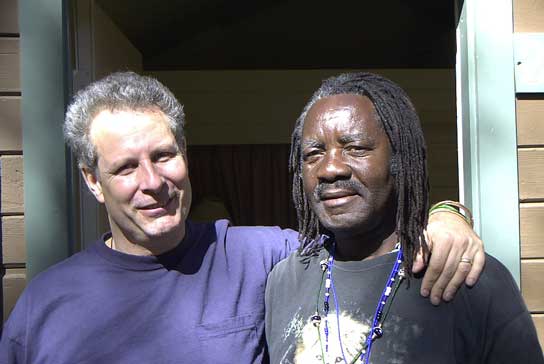
Ortiz Hill and Mandaza (Augustine) Kandemwa |
|
INSPIRATION
FOR DARÉ: Dare’ offers us the opportunity to meet as a community-- to heal each other, and address the violence and greed in the world at large. Each of us comes with gifts and needs. Each of us has suffered, and that suffering can turn us back to our community with compassion. Spirit speaks differently, but profoundly, through each of us. Thus together we might find the wisdom to proceed on a path of peacemaking. 1. Dare' begins by calling in the spirits. Everything depends on this. The invocation allows Spirit to inform the participants. It creates a field of knowing and remembering. Dare' also centers on telling dreams and receiving dreams as gifts from the ancestors to the circle. Council and dreams are channels between the world of the living and the world of the invisibles. 2. The strength and essence of Dare' is in the circle and its intelligence. Council is its heart. Council is the process we use when we sit in circle as a community and discuss a topic or issue. We use the talking stick-- whoever holds the talking stick speaks without interruption, though with an awareness of sharing time with others who want to speak. And in council one always speaks from the heart, allowing the spirits and ancestors to speak through you. Wisdom comes from the combined voices and presence of everyone who is participating. The purpose of council is to seek answers, ideas and wisdom from the community that we can't find ourselves. Asking and addressing a single question coheres the community. 3. Music is an essential element of Dare'. For thousands of years, music has been a way for people to call spirit, and for spirit to manifest itself. Here, the voice, the drum, the dancing body, and other instruments are essential components for invocation, as well as healing. 4. Dare' is for the sake of healing, but we don't presume to say we know what healing is, how it occurs or even how, always, to recognize it. Sometimes one is the healer and sometimes one is desperate for healing. Sometimes the two activities are one and the same. 5. Another concern of Dare' is peacemaking. Again, though we don't always know how peacemaking happens, we have determined to make it the center and ground of council, asking spirit to show us how to proceed. 6. Everyone is welcome and welcomed in Dare'. Everyone is listened to and heard without judgment. This generous mind is not easy to attain; it takes time, practice and dedication. Welcoming, praising and blessing are at the core of it. Dare' is a place where each person's individual genius, intelligence and particularity is sought out, acknowledged and called forth. 7. There are no fees for Dare'. It is pot-luck food and drink. We are especially pleased when contributions are organic and substantial, as the time of Dare' covers two meals. There is always a community money basket at Dare'. Please add money if you can afford it. Please take money if you need it. 8. Children are important members of Dare'. If you enjoy being with young people, consider offering to give parents a break and hang out with the young folks during some part of the day. Anything from holding a baby to taking kids on a nature walk or some other planned activity. If you're a parent and need some help, please ask. We are learning, as a community, to be there for one another in whatever ways are needed. Children are welcome to be at the pond, fire, sauna and hot tub as long as they are with their parents or another designated adult. 9. And, finally, Dare' is truly composed of all the members of the community: living and non-living, visible and invisible, human and non-human: the people, trees, birds, animals stones and elementals. When all the beings gather, Dare' comes to be. Each Dare' will be different, as we respond to the joys and sufferings of all who have gathered, and as we respond to the circumstances of the times. Dare' will continue as long as we continue to leave each other enriched, enlivened and inspired. MANDAZA KANDEMWA Mandaza (Augustine) Kandemwa is a nganga, a Bantu shaman or medicine man, in the Shona and Ndebele traditions of Zimbabwe, initiated into the ngoma of the water spirits - the Central African tradition of healing and peacemaking. He carries with great heart the ancient African tradition of peacemaking. And it is this tradition of peacemaking, as well as his skill as a healer and initiator, that he offers to us individually and in community in this time of global unrest during his visits to Cape Cod. His visits are an opportunity to gather with Mandaza to experience an indigenous understanding of the interrelatedness of healing, community and peacemaking. A former anti-apartheid activist from Zimbabwe, Mandaza is one of the truly exceptional men of our time, a warm and generous teacher and healer with magnificent gifts and an entourage of spirits, a man of deep and profound laughter and wisdom. Educated in the western traditions of what was then colonial-era Rhodesia, Mandaza was called by the ancestors to the old ways and taught the exceptional art and craft of being a true healer. The Shona and Ndebele tribes have been traditional enemies, a situation greatly exacerbated by the politics of the country. For Mandaza to have been first initiated by an Ndebele elder catapulted him into the role of peacemaker. In Bantu culture, the activityof peacemaking and the activity of healing are one and are indivisible from one another. And the work of initiation is about removing the obstacles between the initiate and the spirits. Mandaza introduced Wilderness Sarchild and Chuck Madansky to the idea of Daré in 2001. In Bulawayo, Zimbabwe's second-largest city, Mandaza has re-imagined a tribal form of the Central African tradition of ceremonial healing and council in an urban setting. Daré is a healing community. This means that Daré is a community where healing is the primary focus and concern and the exchange between the participants is constant and dynamic. |
|